Outcome Mapping
Quickly create alignment, focus, and clarity with a group

Steve Pereira
What Is Outcome Mapping?
Outcome Mapping is a collaborative, visual practice designed to align teams around a shared goal and a clear path to achieving it. It emerged out of the need for clear focus before undertaking a Value Stream Mapping workshop, but can be used for any context requiring clarity, alignment, and focus amongst a working group. It creates a simple structured artifact—the Outcome Map—that connects a high-level desired outcome to the specific actions required to achieve it, while explicitly accounting for the obstacles in the way. The map is constructed from left to right, typically following a flow of: Outcome ⇨ Benefits ⇨ Obstacles ⇨ Next Steps. This structure ensures that every proposed action or method is directly contributing to the primary outcome or mitigating a specific obstacle.
In environments where a clear target outcome exists, it can be used to more clearly understand it from various perspectives, as well as account for obstacles and enable action. This can enable support from would-be detractors who were handed a mandate or lack clarity on the benefits or bigger picture implications of a target outcome. In environments with less clarity, it can be supported by Outcome Discovery to capture Ideas, Questions, Pains, Goals, and Context before converging on a target outcome.
The practice is typically conducted in a 2-hour session (facilitated) every 3-6 months to reset direction or aim for a new target once the previous one is achieved or the landscape changes . It can be performed physically with a whiteboard/post-its or virtually using collaboration tools.
Why Do Outcome Mapping?
The primary reason for Outcome Mapping is to generate clarity and alignment, which are cited as the critical missing factors in the 70% of digital transformation efforts that fail. While many organizations have a "compass" (a high-level goal or "North Star"), they often lack a "map" of the terrain—the specific context, obstacles, and path required to get there. Without this map, teams may agree on a destination but have vastly different understandings of specifics or of how to reach it, leading to friction and misaligned efforts.
Outcome Mapping forces the team to explicitly define "Value" before efforts proceed, preventing the common trap of assuming everyone defines success the same way. It shifts the focus from output (features, tasks) to outcomes (value, results), ensuring that work is not just done efficiently but is effective in moving the needle. Furthermore, by identifying obstacles before defining methods, the practice allows teams to design mitigation strategies proactively rather than reacting to roadblocks mid-stream. This shared visual understanding serves as a support for collaboration, and a critical artifact for future reference, allowing everyone from the CEO to new hires to follow the same compass.
How to do Outcome Mapping?
The process consists of five distinct stages.
1. Outcome Discovery
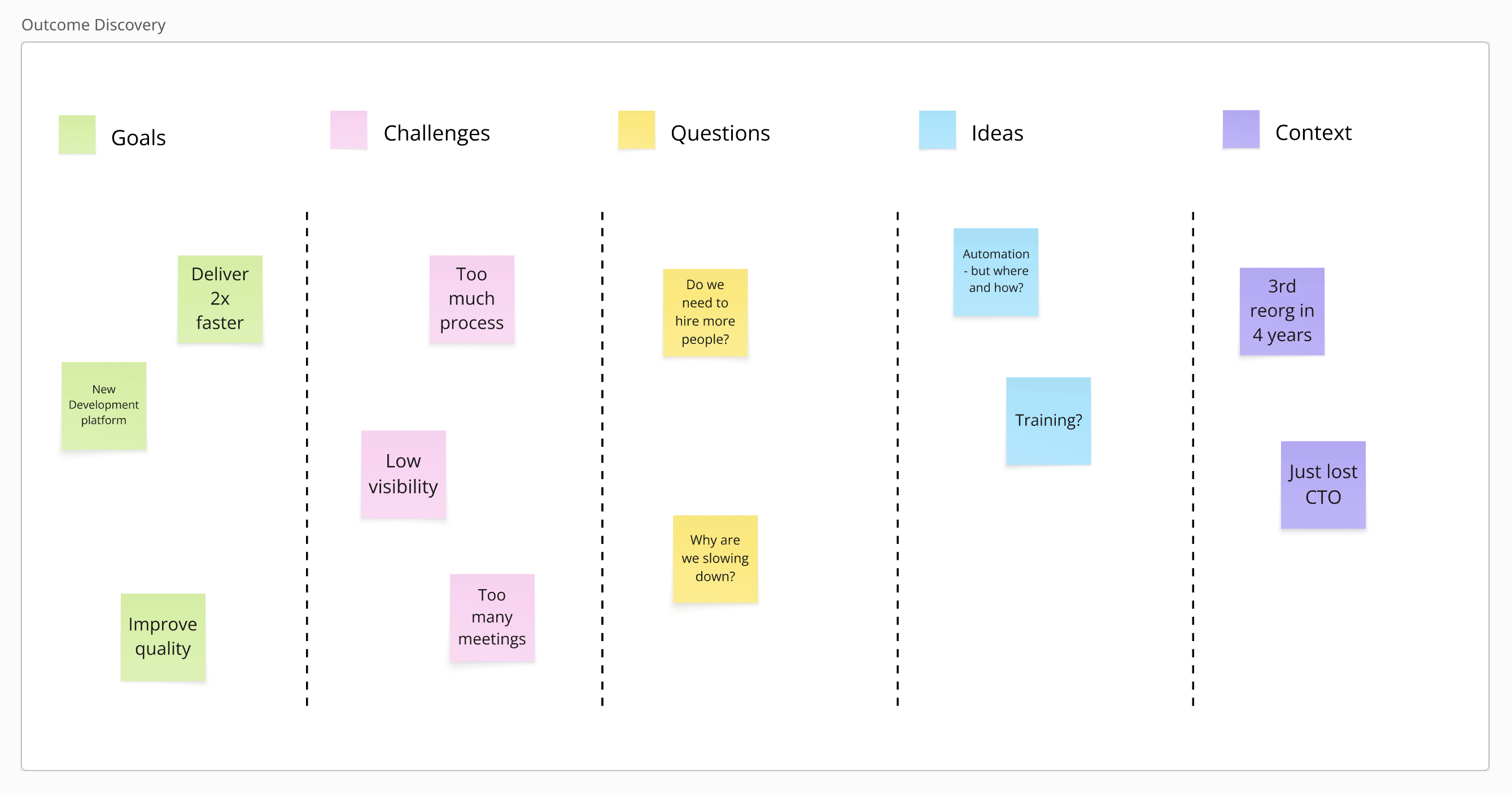
This is a divergent phase. The goal is to surface the various goals, pains, and initiatives currently on everyone's mind. It acknowledges that 8 people will have 8 understandings of problems and solutions until they are visualized and converged.
Fill in items across 5 types: Goals, Pains, Questions, Ideas, and Context
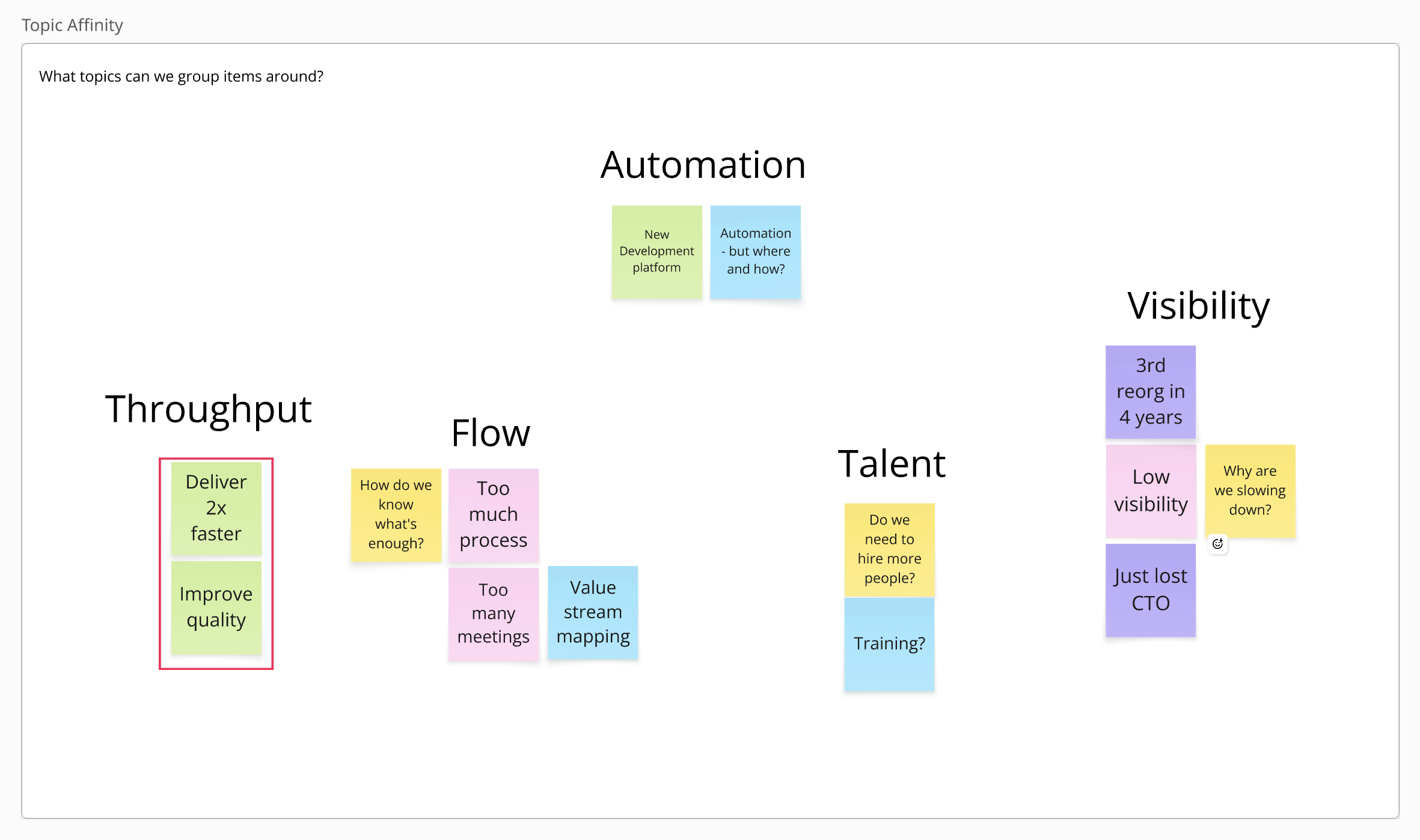
Use Affinity Mapping to capture associations around common themes
Facilitation tips:
- Silent Brainstorming: Give the team 5 minutes of silence to generate sticky notes. Ask prompt questions like, "What is painful right now?" or "What opportunity are we missing?"
- One Idea Per Note: Enforce this strictly to allow for grouping later.
- Categorization: Have the team group duplicates and related themes silently. This reveals the "center of gravity" of the team's concern without the loudest voice dominating.
2. Define the Target Outcome
Context: This is the convergent phase. You must move from "many possible goals" to one clear Target Outcome that will guide the subsequent Value Stream Mapping.
Facilitation tips:
- Dot Voting: Use dot voting (e.g., 3 dots per person) to identify the most critical theme.
- Draft the Statement: collaboratively write a single sentence that captures the goal. It should be Specific and Measurable (e.g., "Reduce onboarding time from 3 weeks to 3 days by Q4").
- Check alignment: Ask, "If we achieve this, does everyone agree it is the most valuable use of our time?"
3. Define Benefits
Context: This validates the value of the target. It answers "Why does this matter?" and builds the business case for the effort. It connects the goal to real business value.
Facilitation tips:
- Stakeholder Perspectives: Explicitly ask for benefits from different angles: "What is the benefit to the Customer?" "To the Business?" "To the Employee?"
- Quantify if possible: If someone says "Efficiency," ask "What will we do with the saved time?"
- Motivation Check: If the benefits list is short or weak, challenge the Target Outcome selected in Step 2. It might not be ambitious enough.
4. Define Obstacles
Context: This anticipates friction. It brings fears and "elephants in the room" out into the open early. These obstacles often hint at the constraints you will find later in the Value Stream or Dependency maps.
Facilitation tips:
- Psychological Safety: Remind the team that identifying obstacles is not "being negative"—it's being realistic.
- Internal vs. External: Encourage them to list things within their control (e.g., "lack of automation") and outside their control (e.g., "compliance review cycles").
- Consolidation: Group these. A massive cluster of obstacles in one area (e.g., "Resource Availability") creates a hypothesis for your next map.
5. Define Next Steps
Context: This prevents "workshop amnesia." It ensures that even if the Flow Engineering process stops here, there is valuable momentum. It also identifies immediate actions that don't require deep mapping.
Facilitation tips:
- Parallel Actions: Identify quick wins or "Just Do It" items that don't need a value stream map to fix.
- Next Workshop: Explicitly schedule the Current State Value Stream Mapping session as a next step.
- Assign Owners: Every sticky note in this column must have a name attached to it.
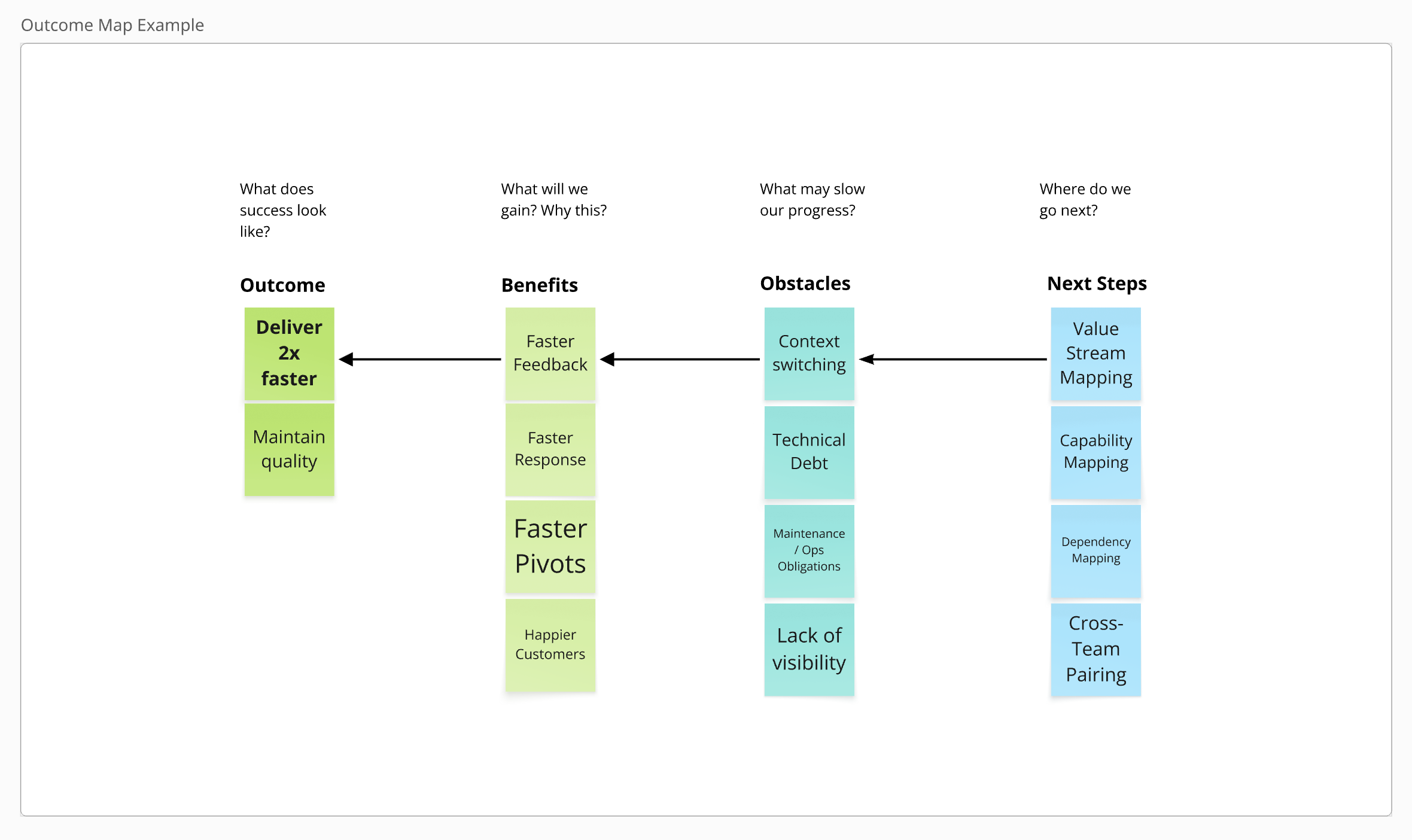
Look at Outcome Mapping

Links we love
Check out these great links which can help you dive a little deeper into running the Outcome Mapping practice with your team, customers or stakeholders.